

This post has been on my mind for some time now, inspired by my fondness for John Atkinson Grimshaw’s painting Queen of the Lilies, painted in 1877 during the Victorian age.

I love the contrast of the wildness of the garden and the idyllic neatness of the young woman walking through it, the bright white of her clothes aligning with the beauty of the tall lilies she holds in her hand. But these paintings speak of something more, something beneath the halcyon and harmonious relationship between flowers and women that comes across on the surface of such depictions at first glance… Are these artistic depictions really about outdated perceptions of femininity? And did they match up with the reality of the time?

The women in these paintings moved through a time when their uniform and behavioural expectations were outwardly beautiful but inwardly confining. Corsets and long dresses constrict you from running freely through such abundance, and I imagine it would have been frowned upon for a well-to-do lady to go feral and tear her hairstyle down by charging into the undergrowth, as the Millennial me has been known to do.
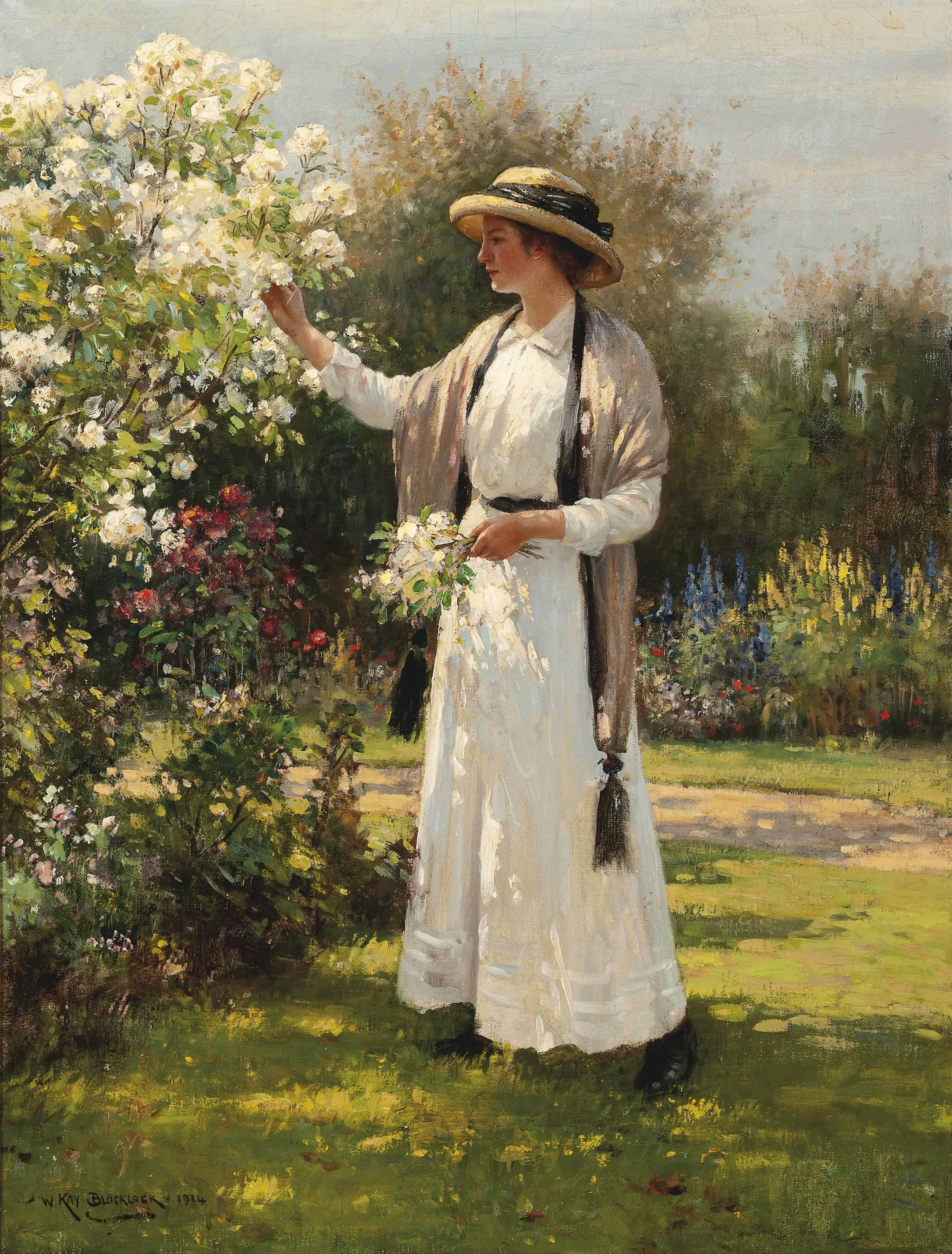
These artists present their female models as passive, delicate as the flowers they hold in their hands. They seem to offer a kind of polite yet fragile relationship between women and their gardens that were sometimes exclusively the subject of the male gaze.

However, the writer Romany Reagan argues that the surge in botany among women in the 18th and 19th centuries actually demonstrated one of the first feminine waves, since “the fascination with flowers and, in turn, a desire for a flowery aesthetic, was not initially about dainty innocence but instead showed evidence of a scientific mind” and was one of the few male-dominated study areas that were not gender coded as solely masculine.1 These painters’ muses thus represent one of the fields where aristocratic women had the freedom to explore beyond their gender constraints, roll up their sleeves and get their hands in the Earth, white dresses or no. I particularly love the picture below where the women are surrounded on all sides of the boat by giant water lilies, as though Mother Nature is reclaiming them Herself!

Unlike the mild mannerisms of these paintings, I knew the human spirit to come alive, let loose and get creative in our gardens could never be absent for long no matter what the trend of the day. And so I decided to find some photographic evidence of Victorians and Edwardians enjoying themselves. Welcome to ‘Fun in the Turn of the Century Garden’…


This painting by Monet was painted slightly earlier than the other pieces included here, in 1867, but faced the most criticism for its vividness and vibrancy, and for Monet’s use of different techniques, which I think make the woman come alive, an intrinsic member of the garden who is connected brilliantly to the foliage surrounding her. This is because Monet painted outside en plein air, in the garden of Monet’s wealthy cousin, and depicted his cousin’s wife, Jeanne-Marguerite Lecadre. She posed outdoors in a completely natural setting rather than in a studio and Monet also used ‘broken’ brush strokes and pure unmixed colour in contrast to traditional painting styles of the day, which used ‘precise’ brush strokes and dulled down colour with a thick gold varnish over the top.2 Its novel composition was among those considered controversial among audiences of his day and Monet encountered initial strong opposition from the public and from the Salon de Paris ~ the city’s annual, juried art show where artists displayed their paintings. However, following on from the Salon’s rejection of at least four of Monet’s paintings and many of his friends’ works during the 1860s, Emperor Napoleon III ordered that the public be allowed to judge Impressionist art for themselves and the Salon des Refusés (Salon of the Refused) was created. This contentious salon ended up being more popular in terms of visitor numbers than the original salon itself! A reminder that we should all break with convention sometimes…
In Love&Light, FS XOX
 Mindfully Stylish
Leave a comment